



name that weed: pilea pumila, or clearweed


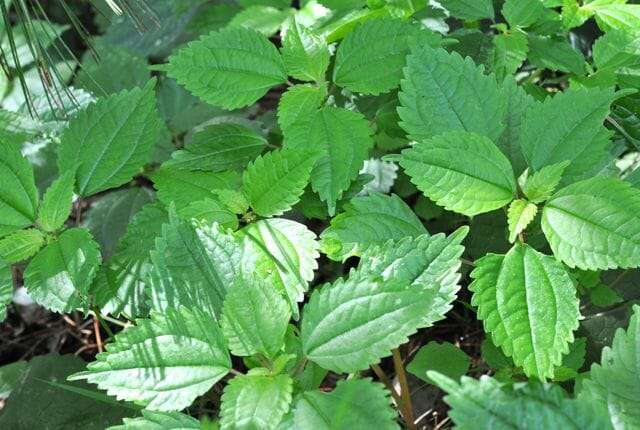 FINALLY: GOTCHA! For decades each summer I have pulled thousands of self-sown seedlings of a plant whose name eluded me, but whose habit and appearance were all too familiar. I’d come upon one stand after another, summer after summer, lurking in masses under shrubs and trees and even under large perennials. But what was its name? And now I know: It’s clearweed, or Pilea pumila, a cousin of stinging nettle (Urtica dioicia) but minus the barbs, and a North American native. A little about Pilea pumila, and about learning to name–and tackle–your weeds. And also why to sometimes leave a little for the native insects to enjoy.
I knew my garlic mustard from lamb’s quarters or mugwort, wild grape from bittersweet or Ampelopsis, oxalis from everything else. But clearweed kept me in the dark longer than most. I could have guessed at its common name, since the stems are practically translucent, or clear. And no wonder I have so much of it: It favors moist soils such as mine generally is, and shady and semi-shady spots in or near woodlands such as the one I garden on the edge of.
The USDA conservation map show the presence of Pilea pumila in 38 states, and parts of eastern Canada. The Flora of North America (efloras [dot] org) says that Native Americans used clearweed medicinally, “to alleviate itching, to cure sinus problems, and to treat excessive hunger.” The Illinois Wildflowers website notes that certain native insects use the plant, too. All these years, the only thing I thought it was useful for? To aggravate me.
Turns out various caterpillars of moths and butterflies enjoy it as a host plant (they’re listed here and include the comma and the red admiral), and so my new policy is to leave a couple of out-of-the-way patches of clearweed to develop at my place. I still pull it from the more formal garden beds.
 pull weeds now, or else
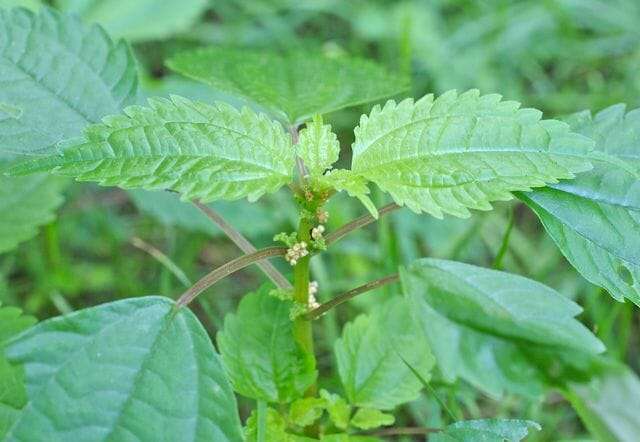
I BRING UP A WARM-SEASON WEED like this right now (high summer/early fall) for two reasons: There are probably a lot of them in general in our gardens, and specifically because a lot of them are about to go to seed as in the detail photo above. Pull now, or expect more next year.
My cardboard technique for making new garden beds can also work for weed-control, and I sometimes spot-smother smaller areas when I can’t keep up with the pulling or digging. Pilea pumila, unlike some of my other more firmly rooted opponents, is easy to slip out of the ground without tools, particular after a rain. Place seed-laden or rhizomatous weeds in a large plastic bag first, to cook them to death, before incorporating them into the compost heap.
identify your weeds
KNOW THY ENEMY. After all, how can you outsmart a plant whose habits you don’t even understand? I think success starts with proper ID, and my article on how to identify weeds, including links to many online tools, can help you get to know yours. Don’t wait as long as I did with clearweed; don’t give them the upper hand in garden beds. Again, however, I leave some clearweed on the looser fringes of my property–as I do with another native “weed,” jewelweed.



I sure have wondered about these for the last 3 years. I can pull up all of them from an area and tomorrow there will be 25 more! At least they are easy to pull and the color is really quite pretty….but only I decide what goes where and this plant goes everywhere!! Thanks.
Glad to have Pilea pumila identified. The good thing about it is that it’s shallow rooted so is easy to pull up. I once had a pet goose that used to eat it. With the abundance of clear weed this year I could use a flock of geese.
I need a flock of geese too, Gerri. You made me smile with your comment. See you soon again, I hope.
The chickens love it!
I too have wondered what this is, many thanks for giving it a name.
Not one of the ones I have to tangle with. I’ve got oxalis, spurge, knotweed, crabgrass, nutsedge, ground ivy, bindweed, and wild violet as my not-so-welcome garden friends.
Out of the flowerbeds! But it’s a native annual that the deer in my area (SE NY State) appear to nibble in the woods. I’m using my energy now pulling stiltgrass instead – a much nastier problem.
I like to think of it as a great groundcover! Seriously, when it comes to weeds at least this one is lush and pretty. It’s one of the last ones I tackle when I get in a weeding mood or one of the first ones I go after when I’m not into it as it is easy to pull. I, too, had no idea what its name was and actually thought it may be a relative of jewel weed, which has similar transparent stems and thrives in moist shady spots. Thanks for the identification.
Much prettier than our weeds…I wish I had that weed instead of mine…I will trade you my blackberries for your Pilea pumila ANY day! ;)
Oh, Clearweed. I ,too, have spent the better part of the last several days clearing beds of this weed. Just when I think I found the last one, there’s always one more! So glad to know what to call it when I’m yanking it out now!
We make a terrific nettle pesto in the spring with young leaves, the stingers are ‘deactivated’ when processed in the Cuisinart. Maybe you could take revenge and ‘pesto’ these also. Good luck!
Whew! I’m inundated with clear weed and am a) happy to have a name for it and b) so glad I spent the past weekend pulling it out of my perennial beds. While it is voluminous, it is not nearly so pesky as the weeds I’m working on that seem to have a web of roots running beneath the soil. For that, I pull what I can and then cover with copious amounts of wood chips and bark mulch. Thank you Margaret!
Hi, Elizabeth. Nice to be on a first-name basis with the thing, right? See you soon again, I hope, and hope all is well (other than the weeds). :)
Interesting. Yes, it actually does resemble 2 familiar Pileas I grow on the windowsill: The Aluminum Plant and Pilea mollis (quilted-looking).
Funny how some plants get to be valued and nurtured while their cousins are just (treated as) pests.
Thank you for the name, I’m feeling very close having spent the weekend pulling it out. Now I can at least put a name to the pest
What a great idea in its simplicity and practicality: creating impromptu solar ovens by putting noxious weeds in plastic bags. Thanks!
What is the best way to get rid of a LOT of it that is not in beds?
I am so comforted to be among friends who likewise live with Pilea and didn’t know its name, either! :)
Sally, since it’s annual, you could mow it well before it sets seed and that would set back the next generation somewhat. The roots won’t overwinter.
Hello to Liz G, Diane and Carol and Hedgerow Rose — looks like you might be first-time commenters (or so the dashboard wants me to believe). Nice to see you (and glad you didn’t bring your Pilea with you).
Oh yes, I have gotten behind on weeding and this is taking over my woods and working it’s wave into my beds. I too wondered what it was. Boy is it prolific and from a distance almost pretty with it’s wave of green. But, out it goes.
You are so right: first know your weeds.
It is verrrry happy in Duanesburg. Fortunately, it is an easy pull!
Thank you, thank you, Thank you!
Every time I pull this weed in August, I wonder what it is. I have looked it up in books and on websites…Why is it never referenced in the major weed identification sources?
Now I know the identification…
As always, I learn so much from “A Way to Garden!”
I have been wondering what this ‘clear weed” was forever! I have masses of it on the edge of my NJ woodland. If it had a commercial application, I would be a millionaire several times over. Thank you!
This has stymied me for the last few years. Many thanks.
Sometimes I make up names for weeds before I find out what they actually are,
this was the”green and soft”
Hey Margaret,
HELP! Spurge and other weeds, along with crabgrass, have taken over my gravel driveway…I tried White Vinegar, Salt and Dawn solution, and it pickled and cooked the unwanted gravel guests, but I was still left with the chore of pulling them – huge and back breaking!
My question: Will the cardboard work on gravel?
Love your blogs and website and your book!
Thanks,
BeBe
My neighbor’s sticky weed keeps trying to invade my garden- it is a vine and it has maple like leaves and the stems are so sticky! Does anyone have an idea what it could be? I have been searching the internet for years!! Thanks!!
Little did I know when I clicked on your link on twitter I’d find out the name of weed that has taken over one of my beds. Thank you for the accidental identification!
This post came at the perfect time; I have about a zillion of these popping up around the compost pile and wondered what kind of weed they were. Thank you!