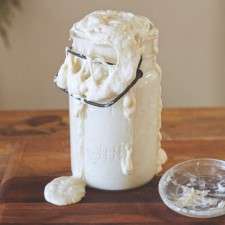


sarah owens’s sourdough starter from her book 'sourdough'
Sarah says that an interesting way to create a starter from scratch involves using raisins to create yeast water. "I call the resulting starter the Mother, because it will give birth to many different recipes," she says. Note: The following measurements require a kitchen scale that will ensure you are able to create and also feed your starter with ample amounts of flour and water, she adds.
Ingredients
- 2 1-liter lidded glass or ceramic containers
- 685 g filtered water
- 150 g granulated sugar
- 65 g raw honey
- 225 g organic raisins not treated with preservatives
- 175 g bread flour
Instructions
- In a saucepan combine 570 g of the water and the sugar over low heat just until dissolved. Once cool, stir in the honey and add to one of your containers along with the raisins. I prefer to use glass containers with a latch top. Seal and place in a warmish location (70 degrees or warmer) of your kitchen. On top of the refrigerator is often a nice spot—just don’t forget about it!
- Give the mixture a thorough shake several times a day and pop the top to allow for adequate air exchange over the next 5 to 7 days. After day 3 or 4 (depending on the ambient temperature of your kitchen) you’ll begin to smell the presence of alcohol. The lid will pop when you open it, releasing carbon dioxide as a by-product of fermentation. This means fermentation is moving along as it should and you are on your way to a happy Mother! Leave the jar loosely covered with a lid at this point, allowing the mixture to “breathe.”
- After day 6 or 7, you should observe bubbles actively rising to the surface. This is an indication that your yeast water is ready. Add 60 g of this yeast water to 60 g of the bread flour in the other container (this is the jar that will house your starter). Stir until thoroughly mixed, and leave covered with a loose lid at room temperature for 8 hours or overnight. After this initial mixing, small bubbles will indicate signs of life. Add the remaining 115 g water and the remaining 115 g flour, position the lid, and allow to ferment at room temperature for another 8 hours.
- You now have your own Mother, kept alive by feedings of equal parts flour and water by weight. After several more feedings, when you drop a tablespoon of starter in a glass of water and it floats instead of sinks, your starter will be ready to leaven bread. Remember, once fed, your starter will double in size. Keep it in a container that will accommodate this expansion.
- I like to keep about 150 g to 300 g of starter on hand at all times. If you bake less, you may only need half of that. Always refresh (feed) your remaining starter after using it in a recipe with an equal weight each of water and flour. If you are only an occasional or weekend baker, the refrigerator is the best home for your starter but will need to be refreshed (fed) twice before it will be strong enough to leaven bread dough. If you need to discard some of the starter to make room for a feeding, consider using it in one of the many recipes from my book Sourdough that uses starter as an ingredient rather than a leavening agent.
Notes
Excerpted from “Sourdough,” by permission of Roost Books.